

Choose an angle for your audience
Compare ideas using customer relevance and evidence, rather than persuasive wording alone.
Choose one clear reason to care before making several visual variations. A focused angle gives you something specific to evaluate.
Watch the walkthrough
Read the walkthrough steps
- Choose your product in Research.
- Review the angle and supporting evidence. AI ideas are hypotheses.
- Select Create ads from this angle, then check the product.
Start with a customer situation
Describe when and why someone would use the product. “A commuter carrying a bottle in a work bag” is more useful than “everyone who drinks water.” Use genuine customer questions when you have them; treat assumptions as assumptions when you do not.
Compare a few angles
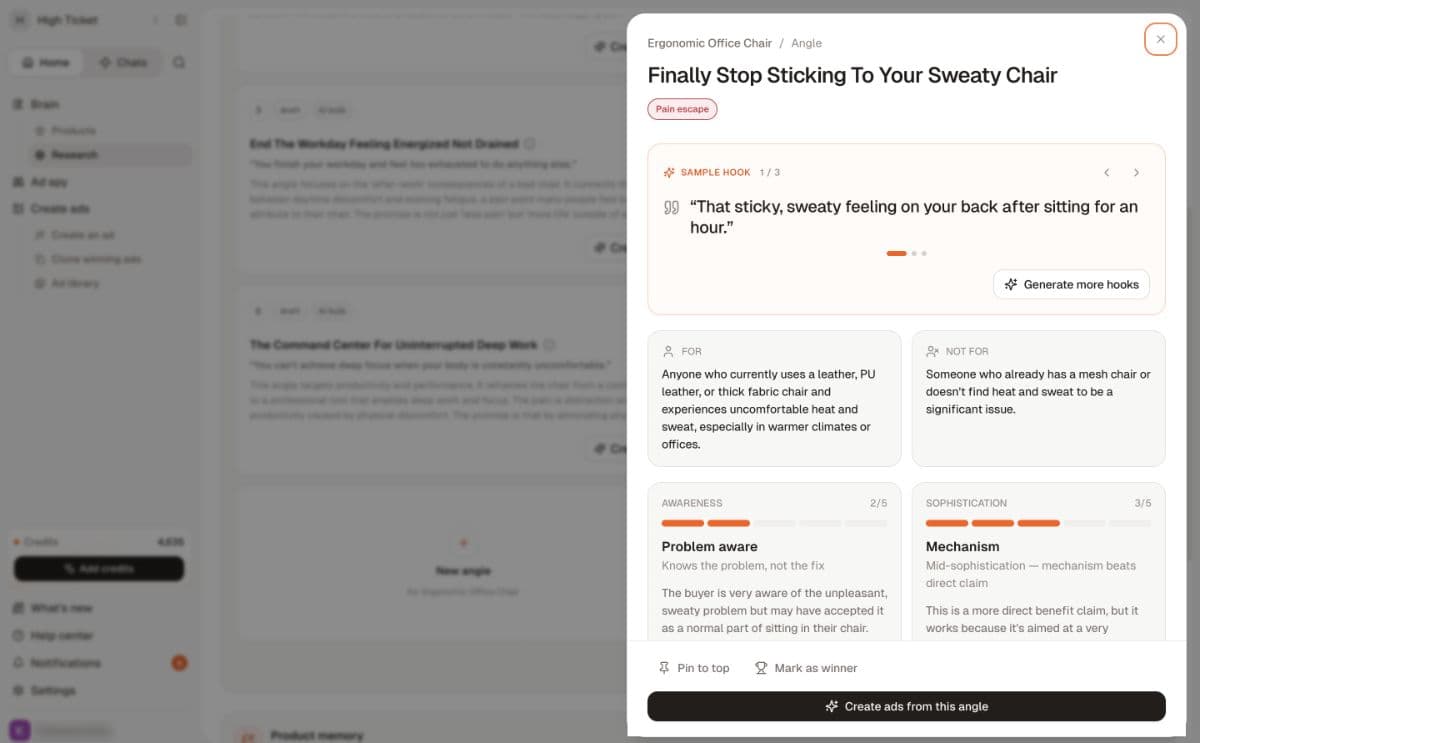
Open angle cards and compare For, Not for, Sample hook and Why it converts. Use this short review:
| Question | What you are looking for |
|---|---|
| Who is this for? | A recognizable customer and situation. |
| What benefit matters? | One relevant reason to choose the product. |
| What supports the claim? | A real feature, demonstration or reliable evidence. |
| What objection remains? | A question the product page or creative should answer. |
| Can I show the idea clearly? | A visual or line of copy that makes sense quickly. |
Understand awareness and sophistication
Awareness describes how much the audience knows about the problem and possible solutions. Someone meeting the category for the first time may need a clearer explanation than someone comparing two familiar products.
Sophistication describes how familiar the audience may be with similar claims. Treat these fields as planning suggestions, not measured facts about every customer.
Check the reasoning
The field Why it converts contains the model's reasoning. It is not a campaign report. Do not use it as evidence that an idea already works.
For the fictional bottle, “easy to carry” can be connected to the carry loop. “Keeps drinks cold for 24 hours” needs separate evidence. If an angle introduces that claim without support, change the idea rather than repeating it in the ad.
Keep a short selection
Use Pin to top to make a promising angle easier to find. Use Mark as winner only when you have evaluated it and the label reflects your evidence. If you are new, keeping it as an idea is fine.
Write down what you want to learn from a test. For example: whether a practical commuting message draws more useful interest than a day-hike message. Sales and ad performance depend on more than the angle alone.
Next, prepare your ad brief or find saved research.
Related
Read an angle · Work with angles · Prepare and review your first ad